
meet people
Learn about the real-world experiences of people living with TK2d, listen to their stories, and gain a better understanding of the impact of TK2d on their lives. Every patient is unique, and their individual experiences may vary. All of their stories are important.


Learn about the real-world experiences of people living with TK2d, listen to their stories, and gain a better understanding of the impact of TK2d on their lives. Every patient is unique, and their individual experiences may vary. All of their stories are important.
Small successes let us know that our best days may still be waiting for us in the future instead of fading away in the past. They give us a reason to keep going.
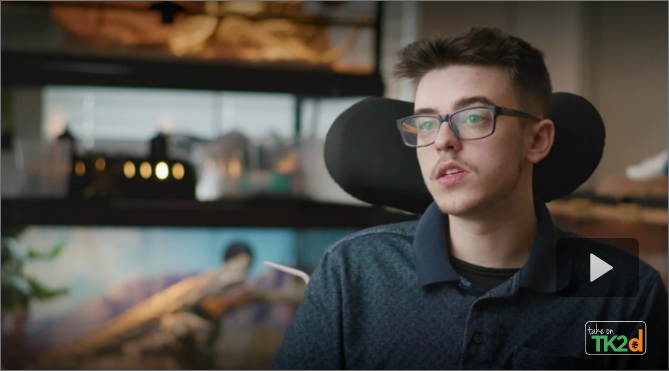
Kamiron: Living a full life
View transcript
Meet Kamiron, who balances the medical needs of TK2d with his life as an athlete, artist, animal lover, and partner to Sierra. Listen to their story.
- Intro card: Kamiron’s Story. Journey with TK2d
- Title card: Kamiron lives with TK2d, a rare mitochondrial disease that progressively weakens his muscles and organs. But he is not his diagnosis. He is an athlete, artist, mentor and partner who challenges what disability and caregiving are supposed to look like.
- Title card: Who I Am
- Kamiron: I’m Kamiron, I’m 22, and I have TK2d. I spend a lot of time, I think, doing active things. Like being very active, especially when it comes to fitness, and I spend a lot of time with my animals. I have lots of animals, so I think I spend a lot of time taking care of them.
- Title card: Journey to Diagnosis
- Kamiron: It took a while to get TK2d confirmed specifically. I think that was in part because we just didn’t have specialists. I started with a very severe autoimmune response when I was an infant. They couldn't wake me up to eat; and I had low muscle tone, I had dyspraxia, I had trouble swallowing, and that kind of continued throughout childhood. I had problems with gastroparesis, motility, and I had issues with constant infections. If there was something going around, I was going to get it. I started having issues with my joints. I started having issues with walking. I started having issues where things would kind of wiggle out of place, or I would feel like I was having pain in my chest. I was having problems with my breathing. I was a teenager who needed my parents to help me get dressed, sometimes before school, because I just, I could not move. As a child and coming into as a teenager, there was a variety of genetic testing, but the issue was that insurance would only pay for parts of genetic testing. They would only pay for specific genes to be tested, specific segments to be tested, specific sex. So, being diagnosed gave me a lot of relief because it was no longer a hunt to find out: Was it something that was going to kill me? Was it something that was going to get worse really, really fast? Was it multiple sclerosis? Was it ALS? You know, there was all sorts of things it could be, and there are worse things and there are better things, and it didn't matter to me which one it was, I just wanted to know. Having a diagnosis means that you can pinpoint a sort of path that things could follow, and that allows you to be prepared emotionally and physically.
- Title card: My Care Team
- Kamiron: My primary physician is an internal medicine specialist, and I see them about once a week. I see orthopedics, I see physical therapy once a week. I see occupational therapy once a week. I see speech therapy once a week. I see urology probably every month or so. And I see gastroenterology right now about every three weeks. And pulmonology, which handles my lungs, I see on average, I would say once every month. I see a neurologist, who is also an epileptologist, and she was actually, probably one of my greatest finds. She specialized in mitochondrial diseases and disorders, which was something I didn't know we had in my area. They've all been extremely knowledgeable and they're all phenomenal at working together. And that, I think, is so key and so core that they're able to communicate with each other as providers because you have to look at the whole body.
- Sierra: My name is Sierra. I’m Kamiron’s partner as well as one of his caregivers. The hardest moment we faced together was about six months to a year into our relationship, was really one of the big, one of the big declines in his condition happened. He was in the bathroom standing, and all of a sudden, his legs gave out. He couldn’t get back up and after that, he had to rely on the use of forearm crutches to get around. And then a few months after that, he lost the use of his bladder as well. So, that was really when we started recognizing that, okay, this is, you know, getting worse and worse and he's losing more abilities.
- Title card: What Living with TK2d Is Truly Like
- Kamiron: I think the fatigue has also gotten a little bit worse. Like, I get tired a lot more easily. I'm very active. I do a lot of sports, but I can’t do them like I used to. I can’t go out. I used to go out for hours snowboarding and sure, I would be absolutely exhausted by the end of it. But now, you know, an hour in and I'm like, all right, my arms are given out, you know. I used to think it was a problem of being out of shape, and I just needed to work those muscles harder. And then if I just kept working on it, working on it, you know, it's a fight to try to build muscle while muscles trying to waste. I feel like sometimes the medical side of my life tries to dominate the other side of my life. And it’s become a balance between trying to keep them separate while also convincing them to work together. I have a lot of appointments, so a lot of my day is spent traveling to appointments, from appointments, at appointments, preparing for appointments. I've been better with hospital visits in the more recent years. It used to be a lot of hospital visits and inpatient admissions, especially for infections or problems with my breathing. There's a lot of medical equipment in my home and sometimes things have to accommodate around that. I have to think about, you know, well, I can’t put that couch there because where am I going to put this? And that can be difficult, especially with the routine. There’s a lot of medical routine.
- Title card: Hope for the Future
- Sophie: I see hope as living in the present moment with Kamiron. It can be easy to get caught up with hope for the future, in a long term sense. I see hope as love, as caring for a person, your friend, your family, in the day to day. And valuing and cherishing that.
- Sierra: My hopes for the future, whether they’re realistic or not, is that Kamiron is going to get to live a long life. Of course I want him here for selfish reasons as well. But, you know, he does so many different things, and I want him to see everything, and I want to give him the world. And I just want you to be happy. And I want you to get old. I want to be old and happy on our porch someday.
- Title card: I Am More Than My Diagnosis
- Kamiron: I hope my story empowers other people. I hope that it drives them to have a fulfilling life, it drives them to try things that they didn't know they could try, that it drives them to be active, that it reminds them that they can have a fulfilling, full life regardless of the adaptations that have to be put in place.
- Title card: Together, we have the power to take on TK2d
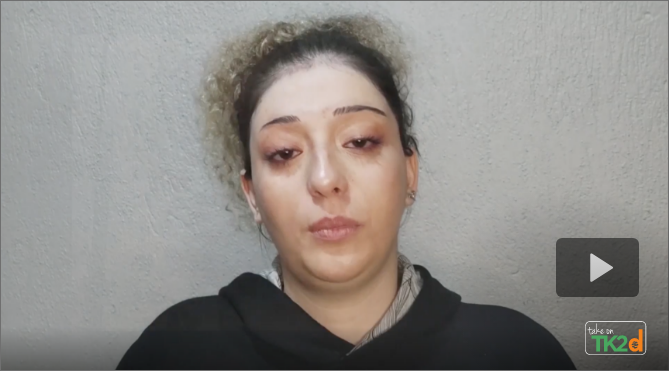
Yagmur: The journey to diagnosis
View transcript
Join Yagmur as she talks about her long journey to a TK2d diagnosis and what finally finding a name for the cause of her symptoms means to her. Listen to her story.
- Intro card: Meet Yagmur, who lives with thymidine kinase 2 deficiency (TK2d)
- Title card: Yagmur lives in Turkey with her parents. She is an advocate for people affected by TK2d.
- Yagmur: My name is Yagmur Kiris. I'm 27 years old. I live in Turkey. I'm diagnosed with TK2d.
- Title card: Recognizing TK2d
- Title card: A normal healthy baby
- Yagmur: When I was born, all test results and my appearance were like that of a normal, healthy baby. My mother didn't notice any abnormalities in my development until I was 1 year old, then she noticed I was getting support from my knees when I was trying to stand up. Following many examinations, tests, and analyses, I was diagnosed with mitochondrial myopathy at the age of 2. But we didn't know, for many years, that this was an incomplete diagnosis.
- Title card: Growing up with TK2d presented challenges
- Title card: Feeling excluded and having difficulty in expressing yourself was even harder
- Yagmur: Not being able to play with peers was hard enough for a 6-year-old child. But feeling excluded and having difficulty in expressing yourself was even harder.
- Title card: I had mild weakness until 15 years of age
- Yagmur: I had mild weakness until 15 years of age. Like difficulty in walking up the stairs and needing support when walking. But now I'm thinking what will happen in the future as the disease progresses.
- Title card: For Yagmur, a definitive diagnosis brought clarity
- Yagmur: For me to be diagnosed took exactly 21 years. I finally became acquainted with it in real terms as a result of my whole gene analysis.
- Title card: Things that were not understood before started to make sense.
- Yagmur: This was like learning the name of something that I know everything about. Things that were not understood before started to make sense. The reason why the diagnosis process took this long was probably lack of information about the symptoms of TK2d, and lack of information about the course of it.
- Title card: If it's not visible to the eye, it doesn't make an impact.
- Yagmur: Unfortunately, there is a longstanding prejudice towards rare diseases such as this one. If the signs aren't revealed through tests, or if it's not visible to the eye, it doesn't make an impact.
- Title card: together, we have the power to take on TK2d
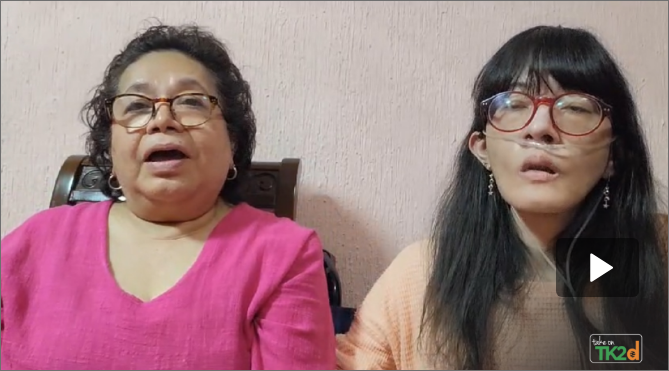
Fanny and Luz: The impact of TK2d
View transcript
Meet Fanny and Luz to learn how they take control of the future while managing the impact that TK2d has on their daily lives. Listen to their story.
-
- Intro card: Meet Fanny, who lives with thymidine kinase 2 deficiency (TK2d)
- Title card: Fanny communicates with an augmentative and alternative communication device due to TK2d symptoms.
- Title card: Fanny was diagnosed with TK2d at 27 years old
- Super: Thymidine kinase deficiency type 2 (TK2d) is a genetic mitochondrial disorder.
- Fanny: Hi. My name is Fanny, and I am 32 years old.
- Luz: Hello. My name is Luz Maria. I'm here with her because due to TK2d, she no longer has the ability to speak.
- Title card: Fanny's journey to diagnosis
- Luz: The first thing I did was take her to orthopedics to find out why she fell down so much. One orthopedist referred us to a doctor who actually specializes in muscular dystrophy. This doctor started to see her when she was 4 years old, and well, diagnosed her as having muscular dystrophy. All these years, we thought that was the illness she had. Then, this very same doctor said she no longer knew what illness it was.
- Title card: My instincts told me I didn't have a dystrophy
- Fanny: That's when I was referred to a neurologist, who worked with a geneticist, who wanted to order genetic testing for muscular dystrophy. My instincts told me I didn't have a dystrophy, so I declined and saw a different geneticist. He recommended whole-exome sequencing, which showed that I have TK2d.
- Title card: The impact of TK2d on Fanny and her family
- Title card: TK2d has isolated me
- Fanny: TK2d has isolated me in some ways. Little by little, I had to quit going to school and going out with friends.
- Luz: Well, I'm the one taking care of her. For me to go anywhere, I need to ask others for help.
- Title card: A normal day for Fanny and her mother
- Luz: A regular day for us is waking up, getting ready, washing up, making food, and above all, feeding Fanny because she can no longer eat, chew, and swallow. She has a feeding tube. This food is prescribed by hospital nutritionists. It's administered four times a day, every three hours.
- Title card: There's so much beauty in nature that life feels like a miracle.
- Fanny: Between meals, I try to get some rest or do some of my favorite activities, like reading, playing video games, or knitting. I also love to spend time outdoors, especially by the water. There's so much beauty in nature that life feels like a miracle. There's daily exercises I have to do too, and I often have appointments to attend.
- Title card: Looking forward
- Title card: I am motivated to use my voice to push for the care I need
- Fanny: I take control of my future by advocating for myself. With the love and support of my family, I am motivated to use my voice to push for the care I need, to raise awareness about mitochondrial diseases like TK2d, and to tell my story.
- Title card: together, we have the power to take on TK2d
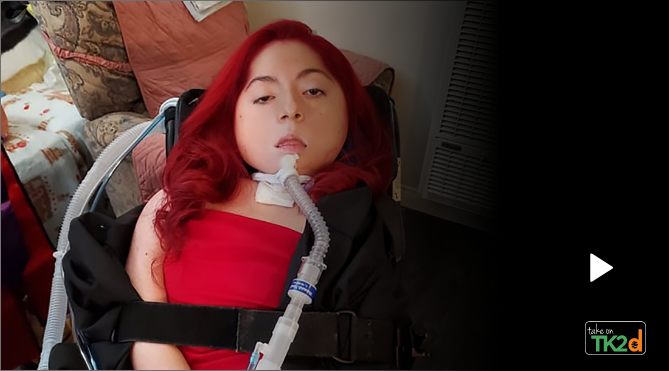
Connie: Misperceptions of TK2d
View transcript
Meet Connie and learn how writing has empowered her to reclaim her narrative and address society’s misperceptions about TK2d. Listen to her story.
- Intro card: Meet Connie, who lives with thymidine kinase 2 deficiency (TK2d)
- Title card: Connie communicates with an augmentative and alternative communication device due to TK2d symptoms.
- Title card: Connie is 27 years old
- Super: Thymidine kinase deficiency type 2 (TK2d) is a genetic mitochondrial disorder.
- Connie: Hi, my name is Connie Morales, and I have a mitochondrial disease known as TK2d. It is a primary mitochondrial myopathy, meaning that it causes muscle weakness. I am an aspiring author and freelance writer with a plan to self-publish a book one day.
- Title card: When I write, I am no longer an anomaly or restricted by the labels others give me.
- Connie: When I write, I am no longer an anomaly or restricted by the labels others give me.
- Title card: Instead, I'm empowered to reclaim my narrative by taking back autonomy over my hopes and needs.
- Connie: Instead, I'm empowered to reclaim my narrative by taking back autonomy over my hopes and needs.
- Title card: Writing will forever be my happy place.
- Connie: Writing will forever be my happy place.
- Title card: Being seen as a person, not a patient
- Title card: explaining TK2d to others
- Connie: When it comes to explaining TK2d to others, I can understand how it sounds a bit complex, especially if it's the first time they've ever heard of it.
- Title card: I usually try to connect it to something more relatable.
- Connie: I usually try to connect it to something more relatable.
- Title card: Sometimes I tell younger kids that I'm secretly a mermaid and that being out of water makes my body tired.
- Connie: Sometimes I tell younger kids that I'm secretly a mermaid and that being out of water makes my body tired.
- Title card: Not better, not worse, just different
- Connie: TK2d may make my body weaker at certain things, but all that means is that I need different types of support than others. Not better, not worse, just different. Some use a fork and spoon to eat, I use a feeding tube. Some use legs to get where they need to go, I use wheels. I have a ventilator which controls the pacing of my breathing, so I may not be able to speak as clearly or as quickly as I want. All that means is I need a little bit of patience. In fact, almost everyone catches on to my accent after a little while.
- Title card: Needing alternative forms of help doesn't take away my mind, feelings, wants, voice, free will, or the chance of a fulfilling life.
- Connie: Needing alternative forms of help doesn't take away my mind, feelings, wants, voice, free will, or the chance of a fulfilling life.
- Title card: society's perception of who I am versus who I actually am
- Connie: However, being able to exercise these things is largely dependent on the lens people perceive me through. The heaviest weight I bear is the incongruence that exists between society's perception of who I am versus who I actually am.
- Title card: mistaken as emotional numbness
- Connie: Due to muscle weakness, I'm very much lacking in the facial expression department, which is sometimes mistaken as emotional numbness. But this notion that I am a passive bystander with no goals, ambitions, or dreams is completely invalid. I have a strong sense of awareness and independence.
- Title card: I want the same things as many others
- Connie: I want the same things as many others. I hope to build a career I love, have opportunities to travel, explore, make friends, maybe find love, and raise a family one day.
- Title card: Connie's advice for others
- Title card: you are your own best advocate
- Connie: That being said, a key piece of advice I'd give to those navigating the maze that is primary mitochondrial myopathy is that you are your own best advocate. Never be afraid to speak up for what you know is best for you. While your medical team, family, friends, and other members of your support group have their hearts in the right place, they may not see beyond a fraction of what your everyday is like.
- Title card: Only you know what you need, and you deserve to be heard, so please, use your voice and make yourself known.
- Connie: Only you know what you need, and you deserve to be heard, so please, use your voice and make yourself known.
- Title card: A positive life and a positive impact
- Title card: Overall, I want to make a positive and lasting impact on the world.
- Connie: Overall, I want to make a positive and lasting impact on the world.
- Title card: While I may not have the smoothest path to reach these goals, I do have one, and I am here.
- Connie: While I may not have the smoothest path to reach these goals, I do have one, and I am here.
- Title card: together, we have the power to take on TK2d
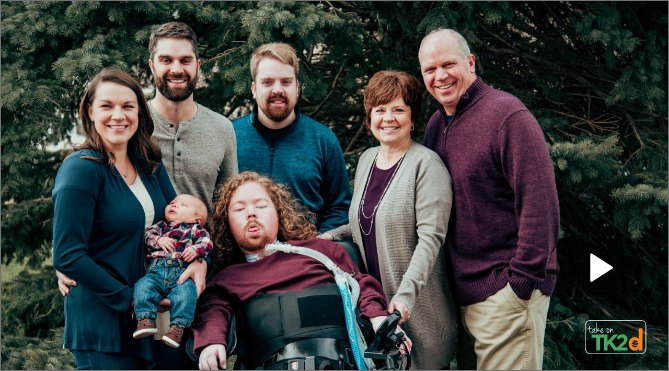
Jared: Life beyond TK2d
View transcript
Meet Jared, an aspiring science fiction writer with a masters in quantum mechanics, and hear how he navigates his life beyond TK2d. Listen to his story.
- Intro card: Meet Jared, who lives with thymidine kinase 2 deficiency (TK2d)
- Title card: Jared communicates with an augmentative and alternative communication device due to TK2d symptoms.
- Title card: Jared was diagnosed with TK2d when he was 2 and a half years old
- Super: Thymidine kinase deficiency type 2 (TK2d) is a genetic mitochondrial disorder.
- Jared: My name is Jared, and I am an aspiring science fiction writer. I live with TK2d, an ultra-rare mitochondrial disease. There are still a lot of things I want to do in my life, and my disability is an obstacle I work around. Sometimes I think that people forget that disabled people are full and complex human beings. Our disabilities are only part of our identities. We have the same fears and desires as anyone else. In school I studied and took exams and stressed about grades like anyone else. I had friends and secret crushes, and I played video games and went to prom. I debated on which college I should go to, and I had to maintain a high enough GPA to keep my scholarships. I got my Masters in quantum mechanics, and I wrote my thesis on Quantum Chaos. I chose that topic because I thought it was interesting, and I'm good at the math involved. I was best man at my brother's wedding, and I'm godfather to his son, Connor. I won't pretend my life is perfect, or that I don't face challenges and deal with mental health problems. Almost every problem I have - breathing, communicating, mobility, etc. - is a direct result of myopathy. My mobility issues are relatively easy to deal with, and I see a psychologist, but things become very difficult when you can't communicate and have difficulty breathing. Words can't describe how horrible it is when you try to take a breath and don't quite get enough air, and then it just gets worse with each passing day. I know my experience isn't unique. I have friends who have been living with TK2d since they were young, too. But for the most part, I'm glad to be alive.
- Title card: Jared's outlook
- Jared: Small successes can be life-changing for us. They let us know that our best days may still be waiting for us in the future instead of fading away in the past. They give us a reason to keep going.
- Title card: together, we have the power to take on TK2d
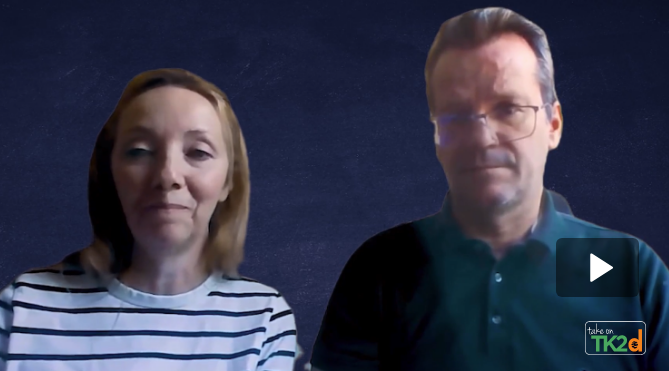
Caregivers' experiences
View transcript
Meet 3 families caring for children with TK2d and hear about their courage, the challenges they face, and daily life. Listen to their stories.
- Title card: These are moments shared from real caregivers reflecting on their journey supporting their child with TK2d
- Intro card: Meet Ruy and Vicky Caregivers to Alex
- Title card: Caring for a person with TK2d means navigating uncertainty and a wide range of emotions.
- Vicky: We were on holiday in Portugal for that Christmas. So, he was 20 months at this point, and he was really unwell. It was the CK levels they detected in his, just a routine blood test that alerted them that there was something else behind the scenes that was wrong. And the minute we came back from the holiday we went straight to our GP. And that started the ball rolling for finding out what was actually wrong with him.
- Ruy: When you don't have any answers and you see your son suffering at this rate and there's no solution, you know, and nobody can tell you what there is. You, you know this, you know.
- Vicky: We were at the mercy of the healthcare system and to be fair our GP referred us to a pediatrician in a hospital nearby. But he was so concerned about Alex's deterioration he referred us on to a neurology, a pediatric neurologist in Dublin in one of the big, large children's hospitals.
- Ruy: He said to us that, look we have to talk about palliative care and there's, there's no hope here. There's no silver lining. And it was... I, you know, I, I never cry in my life. And I left the meeting room and I had to go outside because it was too much.
- Vicky: We were not given any hope that there was going to be anything but Alex going downwards.
- Ruy: It was very traumatic.
- Intro card: Meet Ken and Linda Caregivers to Jared
- Title card: Caring for a person with TK2d takes patience, communication and organization.
- Linda: As longtime caregivers, it's mostly about communication and you know what's going on. He's got to let me know ahead of time when he's got his meetings and his work. If I've got some an opportunity to do something, then I let him know so that we can plan because it's all just about planning to make sure that somebody is always with him.
- Title card: Jared
- Linda: But it's all about communication. And just you know, if you see medicines running low hey, did you get this ordered? Or supplies are running low. Did you get this ordered? Or, is there gas in the van so we can go to the doctor's tomorrow? It's just all about talking.
- Ken: Linda's extremely organized. There's no way that I could ever begin to explain her organization. So, if we take a trip we have or anywhere, if we plan an overnight, we have a checklist. You have to follow the checklist, go through the checklist and make sure that we have everything because we've made mistakes over the years. We've had weird things happening. We've been in a museum and Jared backed into something and busted a filter. And oh, my gosh! We didn't have a filter. We ended up in Pittsburgh and in some hospital in a ER and they're like holy cow! And, people just drop everything and helped us. And later, you just you laugh about what happened because it's like wow, that could have went really bad!
- Title card: Caring for a person with TK2d can feel like you're “racing against time”
- Intro card: Ruy and Vicky caregivers to Alex
- Ruy: He had no strength on his neck, and he couldn't keep his neck up and everything was... he was just floppy. And then that, that was the beginning. And then it started getting to a point that he couldn't even do those movements and he was laying down on the floor without moving at all.
- Vicky: And the problem is it kind of went from normal to not being able to do this so rapidly. We were just racing against time to see what was actually causing this. So, what was happening, and we didn't realize, and it was also in an area that Alex had been affected was his lungs. His muscles for the lung function were weakening and he was not expelling enough carbon dioxide in deep sleep. So, the BiPAP machine was something that we had to put on him every night as part of his a… you know, to assist him. But actually, it turns out that it was part of his treatment really. He was on
- Ruy: NG tube.
- Vicky: Yeah, a nasogastric tube. So, the reason he was given this initially was because his swallow was severely affected so he was not allowed to eat anything. We did a video fluoroscopy which showed that every time he was eating food, unbeknownst to us, he was actually aspirating food and that was actually what was causing his chest infections. We didn't realize this. I mean, we had a very sick little boy, and we just didn't know it. He was really unwell.
- Intro card: Meet Veronica Caregiver to Valen
- Title card: Caregivers supporting a person with TK2d are resilient
- Veronica: I think I'm a strong woman. Brave. Eh..., eh...Who loves her children very much.
- Title card: Valen
- Veronica: And resilient too, resilient, too. I don't know, I don't know where I get strength from because I see Valen, and I think he needs me. The most rewarding thing of being the mother of a child with TK2 is is to see him fight for life. It's about seeing how, with his limitations, he does everything.
- Title card: together, we have the power to take on TK2d
Get updated information about TK2d
Sign up for the latest patient stories, information about TK2d, and links to advocacy groups.All fields are required.
In addition, all of our future communications will include an opportunity to opt out.
WHO WE ARE